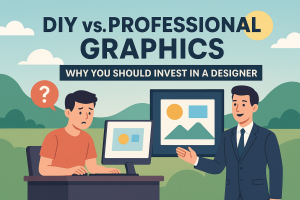
The debate over AI-generated graphics versus human-designed visuals has intensified as artificial intelligence tools become increasingly sophisticated. From marketing campaigns to social media content, businesses and creatives alike are faced with a pressing question: who produces better graphics, the human designer with years of experience or the AI that can generate stunning visuals in seconds?
Speed and Efficiency: AI’s Unmatched Advantage
AI tools like DALL·E, MidJourney, and Canva’s AI image generator can produce images almost instantly. A designer may spend hours sketching concepts, choosing color palettes, and refining layouts, whereas AI can generate multiple variations of a design in a fraction of that time. This speed is particularly advantageous for companies needing high-volume content or rapid prototyping.
However, speed doesn’t always equal quality. While AI can replicate styles and produce technically accurate images, it lacks the intuition and emotional intelligence that a human designer brings to the table. A designer can interpret a brand’s ethos, understand audience psychology, and adapt designs to subtle cultural or emotional cues that AI may overlook.
Creativity and Originality: The Human Edge
Human designers excel in creativity and originality. AI is fundamentally derivative, it generates images based on patterns it has learned from existing data. While this can result in impressive outputs, it is limited to recombining what already exists. True innovation, the kind that breaks conventions and sparks new trends, still relies on human imagination.
Consider iconic brand designs like Apple’s minimalist aesthetic or Nike’s dynamic campaign visuals. These are the results of deliberate thought processes, cultural awareness, and storytelling, qualities AI cannot independently replicate. Human designers can intentionally bend rules, experiment with ambiguity, and create visuals that resonate emotionally with audiences.
Consistency and Brand Identity: A Shared Responsibility
AI can be trained or prompted to follow brand guidelines consistently, producing graphics that adhere to specific color palettes, typography, and visual tone. This makes AI a useful tool for generating content at scale without sacrificing consistency.
Yet, the subtlety of brand identity, the nuanced understanding of a brand’s values, mission, and voice, often requires human oversight. AI can produce the building blocks, but humans provide the final polish, ensuring that every visual communicates the intended message.
Collaboration: The Future of Design
Rather than framing AI and human designers as competitors, a more productive approach is to view them as collaborators. AI can handle repetitive or time-consuming tasks, generate inspiration, and explore a vast array of possibilities quickly. Human designers can focus on curation, storytelling, and the refinement that makes a design truly memorable.
In practice, this hybrid approach is already gaining traction. Creative teams are using AI to generate drafts and explore new directions while humans select, refine, and imbue the designs with meaning. The result is often faster workflows, higher-quality outputs, and more innovative graphics than either could achieve alone.
AI has revolutionized graphic design by offering speed, scalability, and a nearly limitless source of visual ideas. Yet, human designers remain irreplaceable in creativity, emotional insight, and brand storytelling. The real “winner” in the AI vs. human debate isn’t one or the other, it’s the combination of both. By leveraging AI’s capabilities while preserving the human touch, businesses and creatives can produce graphics that are not only efficient but also deeply impactful.
The future of design isn’t AI or human, it’s AI with human intelligence guiding it.
Related Posts: