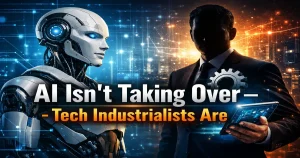
The modern world, defined by digital connectivity, industrial automation, personal computing, and artificial intelligence, did not emerge by accident. It is the product of sustained vision, calculated risk, and industrial-scale execution. While innovation is always collective, certain individuals fundamentally altered the trajectory of global technology by building institutions, platforms, and ecosystems that reshaped how humanity works, communicates, and lives.
This article examines ten global tech industrialists whose influence transcended their companies and permanently altered the structure of modern society. These figures were not merely inventors or executives; they were system builders who redefined entire industries.
1. Bill Gates: Standardizing the Digital World
Bill Gates is the first global tech industrialists who played a decisive role in making personal computing universal. Through Microsoft, he transformed software from a niche technical tool into a standardized global utility. By licensing MS-DOS and later Windows to hardware manufacturers rather than locking it to proprietary machines, Gates enabled an open ecosystem that accelerated mass adoption of personal computers.
The Windows operating system became the default interface for business, education, and government worldwide, shaping how billions of people interact with machines. Gates’ strategic focus on software as the central value layer of computing established the economic model that still governs the tech industry today.
2. Steve Jobs: Humanizing Technology Through Design
Steve Jobs is another one of global tech industrialists who redefined the relationship between humans and machines. While others focused on specifications and enterprise systems, Jobs emphasized simplicity, elegance, and emotional connection. Under his leadership, Apple produced category-defining products, the Macintosh, iPod, iPhone, and iPad, that collapsed complex technology into intuitive experiences.
Jobs’ insistence on vertical integration, industrial design excellence, and ecosystem control reshaped consumer expectations across industries, from smartphones to retail. Modern product design, user experience (UX), and brand-driven technology strategy all trace their lineage to his philosophy.
3. Elon Musk: Industrializing the Future
Elon Musk stands apart as another global tech industrialists who aggressively industrialized frontier technologies. Through Tesla, he accelerated the global transition to electric vehicles, forcing legacy automakers to rethink their long-term strategies. Through SpaceX, he disrupted aerospace economics by normalizing reusable rockets, dramatically reducing launch costs.
Musk’s ventures extend into energy storage, satellite internet, and artificial intelligence, reflecting a rare willingness to tackle capital-intensive, high-risk industries traditionally dominated by governments. His influence lies less in invention and more in execution at scale.
4. Jeff Bezos: Reinventing Commerce and Cloud Infrastructure
Jeff Bezos transformed retail into a technology-driven logistics and data business. Amazon’s early focus on customer obsession, supply chain optimization, and long-term reinvestment allowed it to dominate global e-commerce.
More significantly, Amazon Web Services (AWS) became the backbone of the modern internet. By commercializing cloud computing infrastructure, Bezos enabled startups, governments, and enterprises to build scalable digital services without owning physical servers. Today’s digital economy, from streaming platforms to fintech, is structurally dependent on the cloud model Bezos pioneered.
5. Larry Page and Sergey Brin: Organizing the World’s Information
The founders of Google solved one of the most critical problems of the digital age: information overload. Their PageRank algorithm transformed search from a directory into an intelligent ranking system, making the internet navigable and economically viable.
Under their leadership, Google expanded beyond search into advertising, mobile operating systems (Android), mapping, email, artificial intelligence, and cloud services. Google’s data-driven advertising model reshaped global media economics and became the primary revenue engine of the modern web.
6. Jensen Huang: Powering the AI Revolution
Jensen Huang’s leadership at NVIDIA quietly underpins the artificial intelligence boom. Originally focused on graphics processing for gaming, NVIDIA’s GPUs evolved into the dominant hardware platform for machine learning, data centers, and AI research.
Huang recognized early that parallel computing would be essential for AI workloads, positioning NVIDIA at the center of modern computational infrastructure. Today, breakthroughs in generative AI, autonomous systems, and scientific computing are inseparable from NVIDIA’s hardware and software ecosystem.
7. Mark Zuckerberg: Redefining Global Communication
Mark Zuckerberg reshaped human interaction at an unprecedented scale. Facebook, and later Instagram and WhatsApp, became global communication platforms connecting billions of people in real time.
Zuckerberg’s influence extends beyond social networking into digital advertising, political communication, and data ethics. His company’s platforms altered how news spreads, how communities form, and how identities are expressed online, introducing both transformative benefits and profound societal challenges.
8. Jack Ma: Digitizing Commerce in the Developing World
Jack Ma’s Alibaba Group transformed China’s economy by digitizing small and medium-sized enterprises. By building platforms that connected manufacturers, merchants, and consumers, Ma enabled millions of businesses to participate in global trade.
Alibaba’s ecosystem, spanning e-commerce, payments (Alipay), logistics, and cloud computing, demonstrated how technology could leapfrog traditional infrastructure constraints. Ma’s impact is particularly significant in emerging markets, where digital platforms replaced legacy systems entirely.
9. Masayoshi Son: Capitalizing the Information Age
Masayoshi Son’s influence lies in capital allocation rather than product creation. Through SoftBank and the Vision Fund, he shaped the global technology landscape by directing unprecedented investment into high-growth tech companies, including telecommunications, AI, robotics, and mobility.
Son’s thesis that data and artificial intelligence would dominate the future led to aggressive, sometimes controversial, funding strategies. While not all bets succeeded, his role in accelerating global tech expansion is undeniable.
10. Tim Berners-Lee: Building the World Wide Web
Tim Berners-Lee created the foundational architecture of the World Wide Web, enabling documents, hyperlinks, and browsers to function as a unified system. Crucially, he chose not to patent the web, allowing it to remain open and universally accessible.
While Berners-Lee did not build a corporate empire, his decision to keep the web decentralized made every subsequent digital business possible. His work represents one of the most significant acts of technological stewardship in modern history.
Builders of Systems, Not Just Companies
What unites these individuals is not wealth, fame, or invention alone, but the ability to construct scalable systems that reshaped global behavior. They altered how information flows, how goods are produced and distributed, how people communicate, and how economies grow.
The modern world is, in many ways, the cumulative result of their decisions, technical, strategic, and ethical. Understanding their impact is essential not only for appreciating the past, but for navigating the technological future they helped create.
If you would like this adapted for a specific audience, academic, business, African tech ecosystem, or SEO-optimized publication, let me know and I will revise it accordingly.
Related Posts: